
Connecticut’s new child support calculation will go into effect on August 1, 2026. This is a major revision to the Connecticut child support guidelines. These updates to child support introduce significant changes intended to create a more equitable child support result for Connecticut families, shift how courts are expected to approach income, and adjust for modern family structures.
This article will outline the notable changes for the Connecticut child support guidelines.
Expanded Income Schedule Increased to $6,000 Net Weekly
One of the most immediately noticeable updates is the expansion of the child support guidelines schedule to cover net incomes up to $6,000 per week ($312,000 per year). The previous table capped at $4,000 net weekly income which required professionals to use the top child support recommendation, use their own extrapolation method, or create a deviation argument as the schedule simply did not address high income cases. With the new expanded range, courts will now have guideline figures available in more cases. This does not eliminate the need for deviation arguments, but it does shift the starting point.
New Framework for Multi-Parent Families and Changes to the Support Worksheets
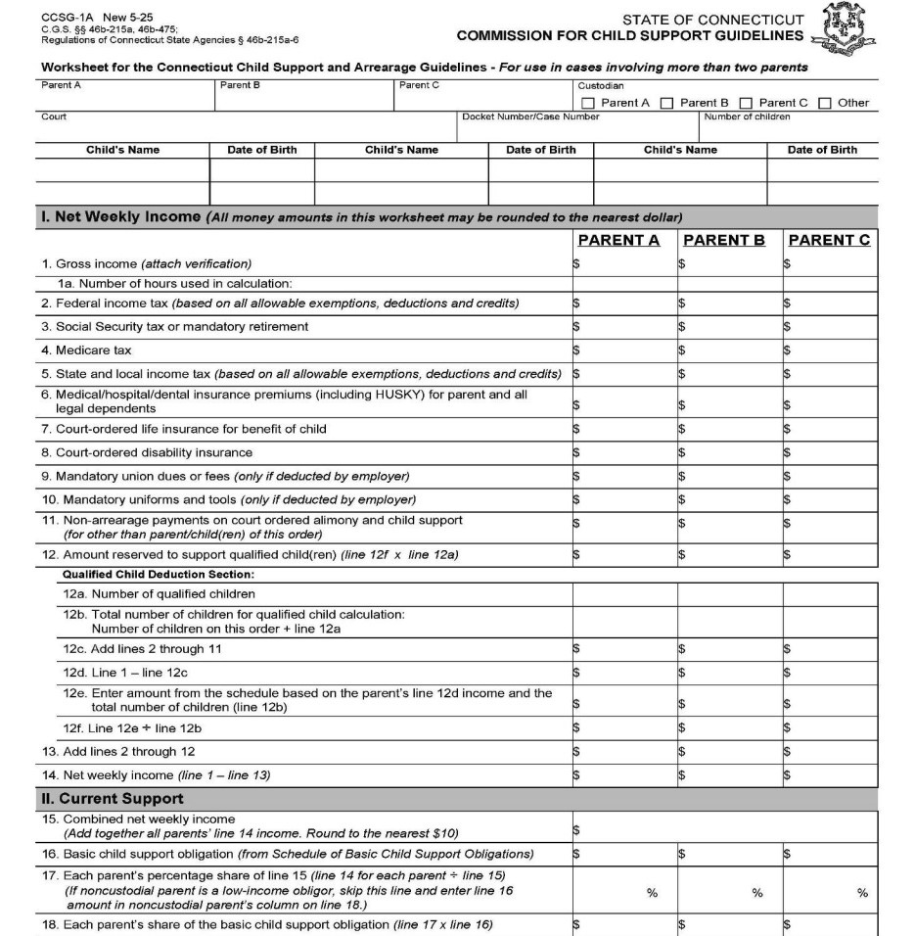
The child support guideline worksheets will have minor changes, but a major development reflects the realities of modern families. The new rule introduces a framework for calculating support in cases involving more than two legally recognized parents, consistent with the Connecticut Parentage Act. A new worksheet with an extra column for a third parent is designed specifically for these situations, but perhaps more importantly, courts are expressly permitted to deviate from the presumptive amount when multiple parents are involved. This is a clear acknowledgment that a rigid formula cannot always produce equitable outcomes in multi-parent cases.
Specifically, the new three parent worksheet, CCSG-1A Worksheet, is for use in cases involving more than two parents. There will be three columns for Parent A, Parent B, and Parent C’s income, taxes, and allowable deductions. The new CCSG-1A provides a methodology for calculating child support and arrearage amounts for situations involving three parents. The basic idea is that the incomes of the three parties are totaled. That total is used to determine the basic obligation. Then, the basic obligation is then divided among the three parties according to their respective incomes.
Should a case involve more than three parents, the judge or family support magistrate shall apply the rules set forth in sections 46b‐215a-2c and 46b-215a-3a of the Regulations of Connecticut State Agencies using multiple worksheets, if necessary, in order to reach a presumptive support amount, and shall consider whether to deviate from this presumptive amount based on the child having more than two legally recognized parents or any other circumstance justifying a deviation under the provisions of section 46b-215a-5c of the Regulations of Connecticut State Agencies.
Preview of new three parent worksheet:
Paid Family and Medical Leave
The new guidelines address Connecticut’s Paid Family and Medical Leave Insurance Program by clarifying how a parent’s contributions should be treated in support calculations. While this may seem like a minor adjustment, it eliminates an area of prior ambiguity. The new rule reads, “Enter the parent’s state and local income tax, based on all allowable exemptions, deductions and credits, on line 5. Include on this line mandatory contributions the parent makes to the family and medical leave insurance program established pursuant to public act 19-25 or a similar program offered by another state.” Family Law Software already includes these contributions with state and local taxes.
Social Security Disability Dependency Benefits
More substantive guidance is provided in cases involving Social Security Disability Insurance benefits. When a custodial parent receives a dependency benefit based on the noncustodial parent’s disability, the revised guidelines offer clearer direction on how that benefit should be treated for both ongoing support and arrearage purposes. The new rule applies to arrearage awards and ongoing child support obligations.
Lump sum awards: If a custodial parent receives a retroactive lump-sum dependency benefit, the court will reduce any child support arrears that built during the same time period the payment covers.
Monthly awards: Ongoing monthly dependency benefits are applied to reduce the current support obligation. If those benefits exceed the required support, the court may reduce past arrears by up to the total excess amount previously received.
Arrearage Payments After Support Ends
The new guideline also introduces flexibility in addressing arrearages after a child is no longer eligible for ongoing support. Courts will have discretion to set repayment amounts between 20% and 100% of an imputed support order.
For example, if a parent has accumulated a debt of past-due child support, but the child is now an adult, there would be no current obligation to pay ongoing support for the child. Let’s assume the past payments were set at $300 or the court found that to be a reasonable support payment. Under the new law, the judge can then order a weekly payment between 20% and 100% of that amount, meaning between $60 and $300 per week. This creates a structured framework to ensure past-due child support is paid.
Defined Criteria for Income Imputation
Income imputation is a contentious issue in many family law cases. The new rule sets forth criteria that must be considered, to the extent known, when determining whether and how to impute income to a parent.
New Rule: Sec. 5. Section 46b-215a-5c of the Regulations of Connecticut State Agencies is amended by adding subsection (c) as follows:
(c) Criteria for Imputation of Income.
(1) If a deviation is considered under subsection (b) of this section that would result in income being imputed to the obligor, the amount of income to be imputed shall be determined only after considering, to the extent known, the following criteria:
(A) The obligor’s:
(i) Assets;
(ii) Residence;
(iii) Employment and earnings history;
(iv) Job skills, educational attainment, and literacy,
(v) Age;
(vi) Health;
(vii) Criminal record and other employment barriers; and
(viii) Record of seeking work;
(B) Information concerning the local job market and the availability of employers willing to hire the obligor, and the prevailing earnings level in the local community; and
(C) Any other relevant background factors of which there is evidence.
(2) For purposes of imputing income, full-time employment shall be considered employment at thirty-two hours per week.
This added guidance should promote greater consistency across cases, but it also raises the bar for practitioners. Lawyers will need to present thorough evidence regarding employment history, earning capacity, and information regarding the local job market.
Union Dues
The new guideline removes the requirement that union dues and fees be mandatory in order to qualify as a deduction in parent’s net income for guideline purposes. Attorneys should take care to review pay stubs and supporting documentation to ensure all eligible deductions are captured.
Credit for Other Child Support Orders
The guidelines permit obligors to deduct court-ordered child support for another child regardless of whether they are currently paying that obligation, so long as it is not an arrearage payment.
For example, if a judge is calculating child support in a new case, and the payor is subject to a previous child support order of $450 a week, the court will deduct that amount from the payor’s weekly income, even if the payor is not currently making those payments. This reduces the parent’s net income resulting in a lower child support amount for the new case. This rule ensures that the parent’s existing legal obligation to another child is taken into account when setting a new support order.
Moving Forward
Family Law Software is at work updating the Connecticut child support calculator to reflect these changes. The updated calculation will be available before the effective date of August 1, 2026 for family law practitioners to prepare for the new changes.
Helpful Resources:
Connecticut Child Support and Arrearage Guidelines (Notated): https://eregulations.ct.gov/eRegsPortal/Search/getDocument?guid=%7B70C1DC9C-0000-C710-8647-5861DD8CDD2E%7D
Source material: https://eregulations.ct.gov/eRegsPortal/Search/getDocument?guid={4061709B-0000-C517-BD9B-45876FF52FA4}