
The formula has changed. DissoMaster is gone. Staying current with taxes and changing laws is not optional. Here’s what’s driving child support numbers in California today.
California child support isn’t a negotiation; it’s a mathematical formula. Courts apply a statewide uniform guideline under California Family Code § 4052 and § 4055, and judges are required to follow it. Attorneys and the courts must also use child support tools certified by the California Judicial Council. Deviations from the guideline are the exception, not a guarantee. For divorce attorneys, financial professionals, and parents trying to understand what the numbers mean, knowing exactly how the formula works, and what changed since September 1, 2024, is critical.
The Core Formula for 1 child: CS = K[HN – (H%)(TN)]
California’s guideline formula looks deceptively simple. Once unpacked, it contains five variables that drive every child support calculation:
- CS — the monthly child support amount
- K — the share of combined monthly parental income allocated to child support
- HN — the higher-earning parent’s net monthly disposable income
- H% — the percentage of time the higher earner spends with the children
- TN — both parents’ combined net monthly disposable income
The K factor is where most of the complexity lives. It scales based on combined income and H%. Based on combined net incomes, first determine the multiple using this chart:
| Total Net Disposable Income Per Month | Multiple |
| $0–2,900 | 0.165 + TN/82,857 |
| $2,901–5,000 | 0.131 + TN/42,149 |
| $5,001–10,000 | 0.250 |
| $10,001–15,000 | 0.10 + 1,499/TN |
| Over $15,000 | 0.12 + 1,200/TN |
Then, the K factor is: (the multiple in the chart above) * (1 + H% if H% < 50% and 2 – H% if H% > 50%). H% is the percent of time that the higher income parent spends with the children.
The graph below shows the K factor for 50-50 parenting for $0 – $40,000 a month of combined net disposable income .
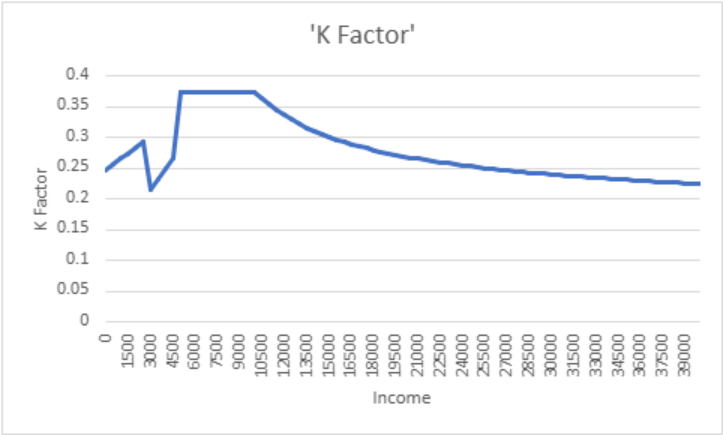
If the higher-income parent spends more time with the children, the K factor decreases slightly, but the shape of the curve remains the same.
For example, if the higher-income parent spends 20% time with the children, then the K factor at $7,500 is 0.3 (30% of income allocable to support), as opposed to 0.375 (37.5%) in the example above with 50% time-sharing.
Looking at the formula, child support will be higher…
- The higher the K factor.
- The higher the higher-income parent’s net disposable income.
- The lower the percent of time the higher-income parent spends with the children.
The graph below shows the child support amount under the formula in a situation in which time-sharing is 50-50 and the lower-income parent has no income.
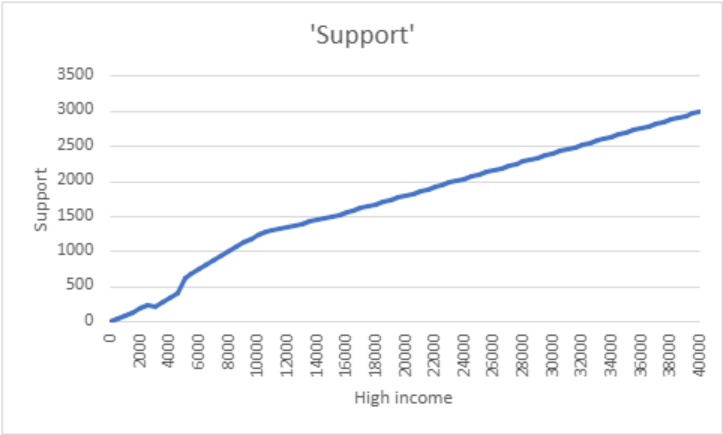
The graph is not linear, and support actually goes down as the paying parent’s net disposable income increases from $2,500 per month to $3,000 per month.
But the California legislature has preferred this formula over the approach of every other state, which is to create a table in which child support increases smoothly with incomes.
Also note that child support continues to increase smoothly, even as parental incomes top $40,000 per month. In most other states, the increment to child support tapers off as parental incomes become very high.
But in any event, changing the calculation paradigm is up to the California legislature. By creating a formula, the legislature has retained control of how child support is calculated, rather than delegating it to an agency or commission.
Multiple children multiply the base CS amount using statutory factors: 1.6x for two children, 2.0x for three, 2.3x for four, and higher for each family size up to 2.86x for ten children.
What Goes Into “Net Disposable Income”
Net disposable income under California Family Code § 4059 is gross income minus a defined list of deductions. This is where client financials require detailed, tax return–level analysis, not paycheck estimates.
Gross income under California Family Code § 4058 casts a wide net, including but not limited to wages, bonuses, commissions, self-employment income, rental income, dividends, pensions, and unemployment, workers’ compensation, disability, and social security benefits. As of September 1, 2024, SB 343 codified that three previously ambiguous sources are included in gross income: severance pay, veterans’ benefits not based on need, and military housing and food allowances. What was once a gray zone is now statutory.
Courts can also impute income when a parent voluntarily reduces earnings or remains underemployed. The analysis considers employment history, education, job skills, age, health, local market conditions, and other specific circumstances (§ 4058(b)(2)). One important exception: incarceration is not treated as voluntary unemployment.
Allowable deductions from gross income include (§4059):
- State and federal income taxes (actual liability, not withholdings or taxes from paychecks)
- FICA contributions
- Mandatory union dues and retirement contributions
- Health and disability insurance premiums
- Court-ordered child or spousal support paid to others
- Job-related expenses (at the court’s discretion considering necessity, benefit to the employee, and other factors)
- So-called “hardship deduction,” which starts as the child support that would be paid for a child of another relationship, reduced through iterative recalculations of the child support amount to resolve the interdependence of child support amounts for children of the relationship and other children. (§§ 4070–4073)
What “Actual Tax Liability” Really Means
The deduction for taxes isn’t the amount withheld from a paycheck, it’s what the parent would actually owe after filing and is based on the financial and tax information entered in the program, including:
- Filing status
- Wage income
- Self-employment income
- Interest, dividends, and capital gains
- Other income
- Health insurance
- IRA, 401(k), and HSA contributions
- Itemized deductions
- Childcare expenses
The program uses this information to calculate federal and state taxes. The result is the tax actually owed for the year, not the withholding figure from a pay stub, which frequently over- or under-estimates tax liability. Getting this number right can shift net disposable income, and therefore the child support obligation, in either direction. Properly analyzing income and tax consequences is critical, as small mistakes can affect the final result.
How Parenting Time Influences Child Support Calculations
H% is an important variable in the formula. The percentage of time the higher-earning parent spends with the children (so-called “H%”) is one of the most significant factors in the formula. Small changes in custody arrangements produce significant swings in the child support obligation.
The parent with primary custody typically receives support, while the non-custodial parent typically pays support, based on their share of parenting time.
For example, moving from alternating weekends (roughly 14% of time) to alternating weekends plus two summer weeks (roughly 18%) can change the H% enough to reduce annual support by hundreds of dollars.
How time gets measured matters. Most California courts count total hours or days across the year and convert that into a percentage. Santa Clara County and other practitioners may take a more standardized approach, assigning predetermined percentages to common schedules. For example: two weekends per month equals 13%, alternating weekends equal 14%, alternating weekends plus two summer weeks equal 18%.
What SB 343 Changed on September 1, 2024
Senate Bill 343 is the first major revision to California’s child support guidelines in years. Four changes have direct, practical impact on every calculation:
Higher baseline support. The K factor increased across most income levels, producing slightly higher child support in almost all cases.
Add-ons are now generally split by income, not 50/50. Add-on expenses like childcare, uninsured medical costs, extracurricular activities, special needs, and travel for visitation were previously split equally between the parties by default. The new presumption is to allocate those costs proportionally to the parties’ net incomes. A parent earning more pays more. The parent earning 70% of combined income now presumptively covers 70% of add-on costs. Courts can order otherwise, but the starting point for analysis has changed.
Work-related childcare carries a rebuttable presumption of reasonableness. Costs actually paid for employment-related childcare are now presumed reasonable unless the other party can rebut that presumption. This shifts the burden in disputes about childcare expenses.
Low-income adjustment threshold increased. The adjustment now applies starting at the amount that one would earn working full time at California’s minimum wage. This increases the threshold from roughly $2,100/month to approximately $2,800/month. A new deviation is also available if applying the adjustment still leaves the obligor’s support obligation above 50% of their net disposable income.
When Courts Can Deviate from the Guideline
The guideline amount is presumptively correct under § 4057, but it can be rebutted with admissible evidence. Valid grounds include extraordinarily high income (where guideline support would exceed the children’s actual needs), a stipulated agreement between parties (with court approval), substantially equal time-sharing combined with significant disparities in housing costs, special medical or developmental needs, a deferred home sale where rental value exceeds carrying costs, and cases involving more than two legal parents, where obligations are divided under § 4052.5.
Any court departing from the guideline must explain their reasoning. They must cite the guideline amount, the reasons for deviation, and why the alternative serves the children’s best interests (§ 4056).
Parents Can Calculate Child Support for Free
Not every person navigating California child support has an attorney. For self-represented parents, Family Law Software offers a free child support calculator. Parents can create a free account and generate California guideline calculations at no cost. The tool creates a child support guideline accounting for income, parenting time, childcare, health insurance, taxes, and other state-specific variables.
These aren’t estimates. Family Law Software’s California calculations are certified by the Judicial Council and accepted in California courts. For a parent trying to understand potential obligations before a first hearing, or to evaluate a proposed settlement, that access matters.
Moving Beyond Dissomaster: A New Era for California Family Law
For decades, DissoMaster was the default tool for California child support calculations. Thomson Reuters, the owner of DissoMaster, discontinued the product in 2024. DissoMaster announced it would not renew its Judicial Council certification, stopped updates in November 2024, and its tax tables stopped reflecting current IRS data as of January 1, 2025. Any attorney still running DissoMaster numbers is generating figures that are both inaccurate and not certified for court use.
California currently has five certified child support calculators. Family Law Software is fully re-certified under the SB 343 updates and the July 2025 federal tax law changes and operates as the only cloud-based platform covering child support, spousal support, the California Declarations of Disclosure, arrears, pensions, property division, and hundreds of Judicial Council forms in a single integrated workflow.
The tools have changed. For California family law professionals, Family Law Software is the only certified, fully updated cloud platform built for where the law stands today.
Helpful Resources:
Free 14-day trial for lawyers and professionals: https://site.familylawsoftware.com/cloudtrial/
Free child support for parents: https://www.familylawsoftware.com/freechildsupport/
California Recertification of Guideline Support Calculators (Family Law Software Recertified as of 04/15/2026): https://courts.ca.gov/programs-initiatives/families-and-children/family-law/ab-1058-child-support-program/guideline-support-calculators